Why position papers matter (and when you need one)

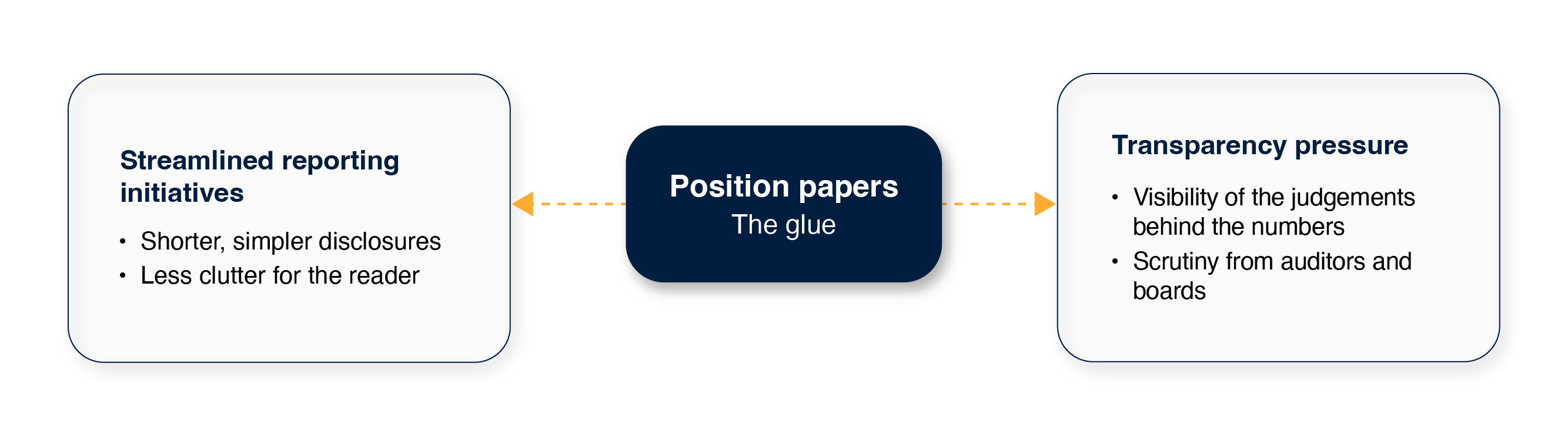
Behind every quality set of financial statements sits a quality set of position papers. The current reporting environment pulls in two directions at once: streamlined reporting initiatives pushing for shorter, simpler disclosures, and growing pressure for transparency around the judgements sitting behind the numbers. Position papers are the glue that holds that tension together. They let the financial statements stay clear and tailored to the entity's actual circumstances, rather than reading like a generic template has been populated. At the same time, they still capture the full weight of the judgement behind the scenes.
Auditors and preparers are both well accustomed to requests for accounting position papers when significant judgements or complex transactions arise. But beyond being another item on the audit request list, why does an accounting position paper matter?
A strong position paper is not prepared for the auditor. It is prepared for management, as the primary evidence that a complex accounting judgement has been properly understood, assessed and approved. Done well, a position paper can strengthen governance, reduce financial reporting risk, improve consistency and provide confidence that complex accounting matters have been properly considered before they become year-end pressure points.
Reporting environment pulling in two directions
When do you need an accounting position paper?
Not every accounting entry needs a position paper. They earn their place when a transaction involves genuine judgement, estimation uncertainty or a non-routine outcome. Common triggers include:
- Revenue recognition (AASB 15) – contracts with multiple performance obligations, variable consideration, or judgement over the timing of control transfer.
- Leases (AASB 16) – determining lease term, discount rates, or whether an arrangement contains a lease at all.
- Impairment (AASB 136) – indicators of impairment in a cash-generating unit, or judgement in recoverable amount assumptions.
- Business combinations (AASB 3) – purchase price allocation, identifying intangible assets, and measuring contingent consideration.
- Provisions (AASB 137) – recognising and measuring obligations where the amount or timing is uncertain, such as restructuring or make-good provisions.
- Financial instruments (AASB 9) – classification, expected credit loss estimates, or judgement over hedge accounting.
If a transaction ticks any of these boxes, it is worth asking whether a position paper should be prepared before the year-end audit, not during it.
What value does a position paper provide?
Beyond audit, a well prepared position paper can deliver value across four distinct areas: strengthening governance, reducing reporting risks, improving consistency, and as a resource for management. Strengthening governance and oversight
Strong accounting position papers give boards, audit committees and senior management a clear basis for understanding significant accounting judgements. Rather than relying on verbal explanations or high-level summaries, decision-makers can see the relevant facts, accounting standards, assumptions, alternatives considered and the rationale for the outcome presented. Effective position papers support better board oversight by providing directors a clear basis to review and challenge outcomes of significant accounting judgement.
Reducing financial reporting risk
Documenting the accounting issue early and assessing it against the relevant framework, can help management identify potential gaps before they become audit findings or reporting issues. This is particularly valuable where the accounting outcome depends on judgement, estimates or interpretation of standards, as it creates a disciplined process for reaching and supporting the correct treatment.
Creating consistency in financial reporting
Position papers help ensure accounting matters are treated consistently across reporting periods, business units and similar transactions. Once management has documented the facts, analysis and conclusion, the paper becomes a reference point for future reporting decisions. This reduces the risk of different teams applying different approaches to similar issues and helps maintain comparability in the financial statements over time. This is particularly beneficial in transferring knowledge between finance personnel and ensuring that regardless of who prepares the accounting entries and financial report, the decision is known and defensible.
Providing support for management decisions
Accounting position papers provide a record of how management reached its accounting conclusion. They show that management considered the relevant facts, applied the appropriate accounting guidance and exercised judgement in a structured way. This is useful not only for auditors, but also for boards, regulators, future finance teams and other stakeholders who may need to understand or revisit the decision later.
What makes a strong position paper?
A high-quality position paper should tell a well-supported story from issue to conclusion. It should clearly address the following areas:
The issue
Explain the accounting issue, judgement or transaction being assessed, and what the paper is seeking to conclude on.
The facts
What has happened to warrant the accounting assessment? Describe the relevant transaction, event or circumstance, including the key facts management has considered.
The applicable accounting standards
Identify which accounting standards apply, so the analysis is anchored to the correct accounting framework.
The analysis
How do the accounting requirements apply to the facts? This is the core of the position paper. It should connect the applicable accounting standards to the background and explain how management has assessed key judgements, estimates and decisions. The analysis should not simply quote the standard, it should demonstrate how the requirements have been applied in practice.
Alternatives considered
Include any other reasonable interpretations or treatments that were assessed, and clear rationale as to why they were ruled out.
The conclusion
The paper should clearly state the accounting outcome, including the impact on recognition, measurement, presentation, disclosure and any related accounting entries.
Sign-off
Formal review and approval by the appropriate level of management, evidencing that the judgement has been properly considered and owned.
Position paper in action: a worked example
Consider a manufacturing business that has seen earnings soften in one of its cash-generating units (CGU) due to softer demand. The finance team identifies this as a potential impairment indicator under AASB 136.
- The issue: does the softer performance indicate the CGU's carrying amount may not be recoverable?
- The facts: three consecutive quarters of declining margin, a revised budget showing lower forecast cash flows, and no offsetting asset revaluation.
- The relevant standard: AASB 136 Impairment of Assets, which requires an impairment test where indicators exist.
- The analysis: management builds a value-in-use model, tests key assumptions (discount rate, growth rate, terminal value) against market data, and compares the result to the CGU's carrying amount.
- Alternatives considered: whether a fair value less costs of disposal approach would produce a more reliable estimate, and why value-in-use was preferred given the absence of an active market.
- The conclusion: no impairment is required, but headroom has narrowed materially and sensitivity disclosures are needed.
- Sign-off: reviewed and approved by the CFO ahead of the audit.

Prepared this way, the paper becomes the evidence trail auditors need, and a governance record the board can rely on.
What happens if you don't have one?
Skipping the position paper doesn't remove the judgement, it just defers the pain. Without one, complex accounting matters are often only worked through in detail once the auditor asks the question, which tends to happen at the busiest point of the audit. The practical costs include:
- Audit delays, while the analysis is built from scratch under time pressure.
- Late adjustments that surface close to reporting deadlines.
- Modified audit opinions, where the auditor cannot obtain sufficient appropriate evidence in time.
- Restatements, where a judgement is later found to be unsupported.
Each of these is more expensive, and more visible to the board, than preparing the paper up front.
Summary
Accounting position papers should not be viewed as just another audit deliverable. They are a practical tool for preparers to document complex accounting matters, support management’s decisions and demonstrate that key judgements have been carefully considered.
For preparers, the value is significant. Where transactions involve significant judgement, material estimates, unusual terms or any complex accounting consideration, a position paper should be prepared.
In an environment where transactions are becoming increasingly complex and financial reporting judgements are under greater scrutiny, taking the time to prepare a strong position paper is not just good practice, it is a smart investment in better reporting outcomes.
Sources
https://www.asic.gov.au/regulatory-resources/financial-reporting-and-audit/financial-reporting-and-audit-focus-areas/
https://www.qao.qld.gov.au/sites/default/files/factsheets/preparing_position_papers_for_accounting_matters_and_valuation_1.pdf
https://standards.aasb.gov.au/aasb-108-mar-2021